




Electrical and Electronic Circuits Laboratory
Features:
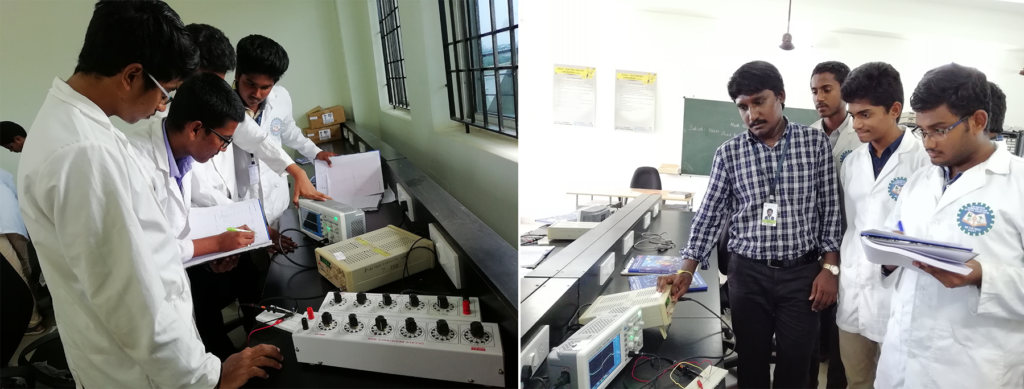
- The Electrical and Electronic Circuits Laboratory is designed to provide students with hands-on experience in the fundamentals of electrical circuits, electrical network laws, and electronic circuit analysis. The laboratory enables students to experimentally verify electrical laws and network theorems, study the characteristics of various semiconductor devices, and analyse the operation of analog and digital electronic circuits. It also provides facilities for circuit simulation, allowing students to design, analyse, and verify circuit performance before practical implementation.
- The laboratory serves as a platform for undergraduate students to develop practical skills in circuit construction, testing, measurement, troubleshooting, and project development. Through a combination of experimental learning and simulation-based analysis, students gain a deeper understanding of theoretical concepts and develop the technical competencies required for electronics design and implementation.
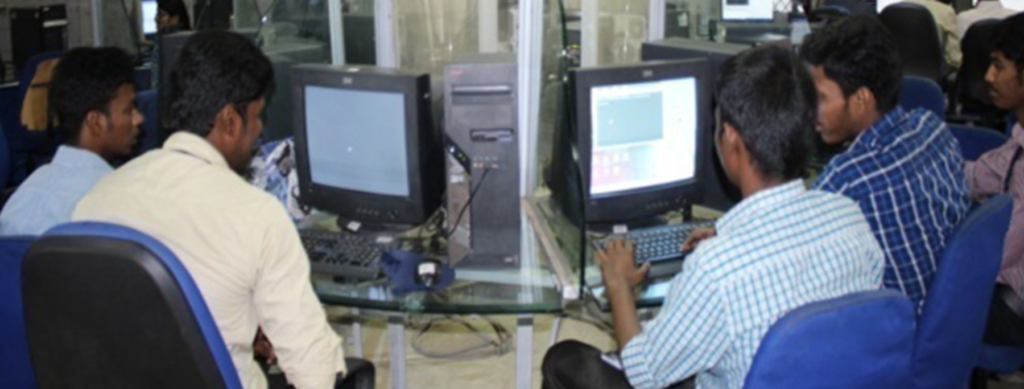
- The laboratory is equipped with Digital Storage Oscilloscopes, Function Generators, Regulated Power Supplies (5 V and ±15 V), AC/DC Voltmeters and Ammeters, Digital Multimeters, and Single-Phase Energy Meters. It also houses a wide range of electronic components, including diodes, Zener diodes, NPN transistors, JFETs, UJTs, photodiodes, phototransistors, resistors, capacitors, and inductors. Breadboards facilitate circuit assembly and experimental verification, while personal computers with circuit simulation software enable students to model, simulate, and validate electrical and electronic circuits.
- Overall, the laboratory provides a comprehensive learning environment that bridges theoretical knowledge with practical application, fostering analytical thinking, experimental skills, and innovation among undergraduate students.


Embedded Systems and Power Electronics Laboratory
Features:
- This Laboratory is designed to provide students with practical knowledge and hands-on experience in power electronic converters, semiconductor switching devices, microprocessors, microcontrollers, digital signal processors, and embedded system development. The laboratory enables students to understand the operating characteristics of power semiconductor devices and their applications in rectifiers, inverters, choppers, and resonant converters.
- Experiments involving the analysis of output voltage and current waveforms of six-pulse AC–DC converters, current source inverters, and Zero Voltage Switching (ZVS) and Zero Current Switching (ZCS) converters help students develop a deeper understanding of power conversion techniques and switching behaviour.
- The laboratory also provides facilities for studying 8-bit and 16-bit microprocessors and microcontrollers, including the 8085, 8086, and 8051. Students gain practical experience in interfacing input and output devices and peripherals such as traffic light controllers, stepper motors, Analog-to-Digital Converters (ADC), Digital-to-Analog Converters (DAC), Liquid Crystal Displays (LCD), keyboards, and sensors. These experiments develop their skills in hardware interfacing, embedded programming, real-time control, and microprocessor-based system design.
- The laboratory is equipped with 32 computer systems with a comprehensive range of development boards, trainer kits, and evaluation platforms, including the 8051 8-bit Microcontroller Development Board, MSP430 16-bit Processor Development Board, PIC Microcontroller Development Board, ARM7 LPC2148 RTOS-based Development Board, ARM9 STK9302 Trainer cum Development Board, Xilinx FPGA Spartan Trainer (FPGA-A), Xilinx CPLD Spartan Trainer (CPLD-B), TMS320C6713 DSP Starter Kit, TMS320C6745 Floating- and Fixed-Point DSP Trainer, Stellaris LM3S1968 Evaluation Kit, DM6446 DSP+ARM-based DaVinci EVM Bundle, and Sitara AM335x Starter Kit.
- The laboratory is further supported by software tools such as Code Composer Studio IDE and LabVIEW, which facilitate embedded software development, digital signal processing, system interfacing, and control applications. These facilities enable students to design, implement, test, and troubleshoot embedded and power electronic systems through practical experimentation.
- Overall, the laboratory provides an integrated learning environment that bridges power electronics, embedded systems, microprocessor applications, and digital signal processing. It supports the development of technical competence, problem-solving abilities, and design skills essential for careers in power electronics, industrial automation, embedded product development, and intelligent control systems.


Renewable Energy Systems Laboratory
Features:
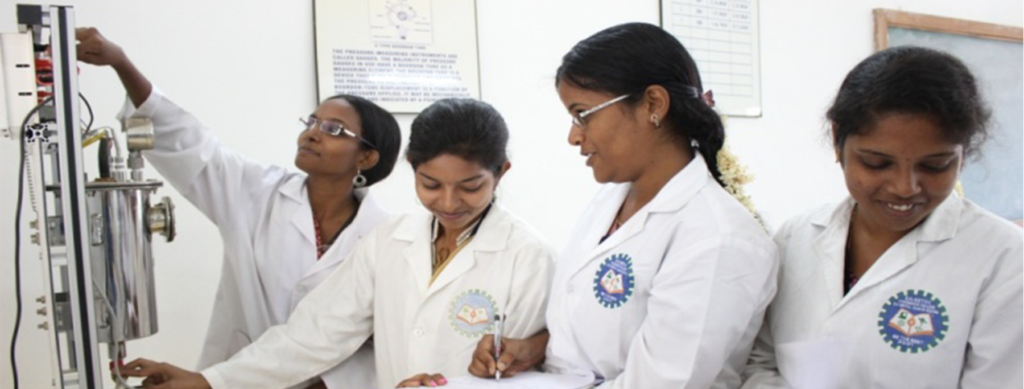
- This Laboratory is established to provide students with practical knowledge and hands-on experience in renewable energy technologies, including solar energy, wind energy, hybrid energy systems, and fuel cells. With the growing demand for sustainable energy solutions and the need to address the challenges associated with conventional energy resources, the laboratory aims to create awareness of the energy crisis and introduce students to alternative energy sources and non-conventional energy technologies. It emphasizes the importance of renewable energy in ensuring sustainable economic growth, improving energy efficiency, and reducing dependence on conventional fossil fuels.
- The laboratory provides facilities for studying the characteristics and performance of solar photovoltaic systems, wind energy conversion systems, hybrid renewable energy systems, and fuel cells. Students gain practical experience in solar photovoltaic energy conversion, maximum power point tracking (MPPT), battery performance assessment, wind energy generation, fuel cell operation, and power quality analysis. These experiments help students understand the operational principles, performance parameters, and practical challenges associated with renewable energy generation and utilization.
- The laboratory is equipped with a 1 kW, 120 V solar panel system, PV Emulator (62050H-600S), MPPT charge controller, battery impedance analyser, microwind turbine trainer system, and a 100 W fuel cell system. It also houses advanced instruments such as a Power Quality (PQ) Analyser, Fluke 438-II Power Quality and Motor Analyser, enabling detailed evaluation of electrical power quality, energy system performance, and motor-related parameters.
- These facilities provide an effective platform for experimental learning, performance evaluation, and project development in renewable energy systems. The laboratory supports students in developing the technical skills required to analyse, design, and evaluate sustainable energy solutions and encourages innovation in clean energy technologies. This Laboratory bridges theoretical knowledge with practical applications in renewable energy generation, storage, and utilization. It prepares undergraduate students to contribute to the development of efficient, reliable, and sustainable energy systems in response to emerging energy challenges.


Control and Instrumentation Laboratory
Features:
- This Laboratory provides students with practical knowledge and hands-on experience in measuring electrical and physical quantities, operating instrumentation systems, and analysing automatic control systems. It develops proficiency in handling measuring instruments and transducers while strengthening their understanding of linear control theory and its practical applications.
- The laboratory facilitates the study of AC and DC bridges, displacement and pressure transducers, RTDs, thermocouples, instrumentation amplifiers, and A/D and D/A converters. Students gain practical experience in signal measurement, transducer calibration, sensor interfacing, and instrumentation circuit analysis.
- Experiments involving DC motor–generator sets, AC and DC servomotors, and Ward–Leonard speed control systems enable students to determine transfer functions, analyse the frequency response of lag, lead, and lag-lead networks, and study P, PI, and PID controllers in second-order systems. MATLAB software is used for system stability analysis and compensator design.
- The laboratory is equipped with AC and DC bridges, displacement and pressure transducers, RTD and thermocouple transducers, A/D and D/A converters, instrumentation amplifiers, lag/lead/lag-lead network trainers, a Ward–Leonard speed control trainer, a DC motor–generator set, P/PI/PID controller trainers, AC and DC servomotors, and single-phase and three-phase energy meters.
- These facilities support experimental learning, system modelling, performance evaluation, and control system design, developing students’ analytical and problem-solving skills for careers in instrumentation, process control, electrical machine control, and industrial automation.


Electrical Power System Simulation Laboratory
Features:
- The Electrical Power System Simulation Laboratory is established to provide students with practical knowledge and hands-on experience in the modelling, simulation, and analysis of electrical power systems. Computer simulation enables students to model real-world electrical systems in a virtual environment, study their operational characteristics, and evaluate their performance under various operating conditions.
- The laboratory provides facilities for simulating electrical power transmission and distribution networks using ETAP (Electrical Transient Analyzer Program), enabling students to analyse system behaviour, investigate operating conditions, and develop effective solutions to power system engineering problems.
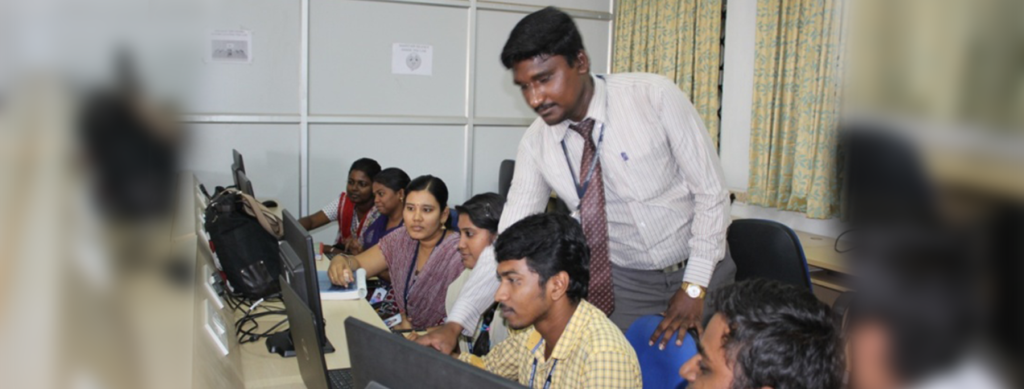
- The laboratory is equipped with 15 Lenovo and 15 HP computer systems, all with internet connectivity, providing a conducive environment for simulation-based learning, technical analysis, and project development. The systems operate on Ubuntu and Windows operating systems and are installed with essential engineering software, including the licensed version of MATLAB 2012 and ETAP. These software tools support computational analysis, modelling, and simulation of electrical engineering systems.
- The laboratory offers students an opportunity to strengthen their understanding of power system concepts through computer-aided analysis and practical exercises. It also supports academic projects, technical skill development, and research activities related to electrical power generation, transmission, distribution, and system performance analysis. Overall, the laboratory bridges theoretical knowledge and practical engineering applications through simulation-based learning and analysis.


AC and DC Machines Laboratory
Features:
- This Laboratory is designed to provide students with practical knowledge and experimental skills in the operation, testing, and performance analysis of DC machines, AC machines, transformers, synchronous machines, and induction motors.
- The laboratory enables students to understand the operating principles and characteristics of various electrical machines through hands-on experiments. Tests such as Swinburne’s test, Hopkinson’s test on DC motor–generator sets, and load tests on different electrical motors and transformers help students determine efficiency, evaluate performance characteristics, and understand the behaviour of machines under varying load conditions.
- The laboratory is equipped with DC shunt, series, and compound generators coupled with DC shunt motors; DC shunt, series, and compound motors with loading arrangements; single-phase and three-phase transformers; a three-phase alternator coupled with a DC shunt generator; three-phase squirrel-cage and slip-ring induction motors; a single-phase induction motor; and a three-phase synchronous motor with a loading arrangement.
- These facilities provide an effective platform for conducting experiments on electrical machine characteristics, speed control, load performance, and efficiency evaluation. The laboratory bridges theoretical concepts with practical applications, helping students develop analytical, experimental, and problem-solving skills essential for electrical machine operation, testing, maintenance, and industrial applications.


AI-Driven Electric Mobility Laboratory
Features:
- The laboratory offers a safe and controlled environment to deliberately introduce faults, subject systems to demanding operating conditions, validate controllers, study battery behaviour, analyse thermal performance, and collect meaningful engineering data. These capabilities enable industry-grade testing and validation, supporting consultancy, sponsored research, and the development of reliable, efficient, and intelligent electric mobility solutions.
- The laboratory is equipped with two fully functional electric vehicle platforms for on-road and off-road trials: a two-wheeler powered by a Brushless DC (BLDC) hub motor and a three-/four-wheeler powered by a BLDC mid-drive motor. These platforms enable continuous monitoring of critical operating parameters, including motor speed, vehicle speed, battery current and voltage, energy consumption, temperature, vibration, and tyre pressure. The collected data facilitate performance evaluation, fault analysis, energy-efficiency studies, and real-world validation of EV technologies.
- The laboratory infrastructure includes a 2-kilowatt programmable battery simulator, power electronics and load-testing facilities, a universal dynamometer, oscilloscopes, and thermal imaging equipment. These resources support the investigation of battery characteristics, power converter performance, motor-drive behaviour, thermal effects, and system responses under varying load and fault conditions. The Speedgoat Hardware-in-the-Loop (HIL) system, integrated with MATLAB and Simulink, enables real-time testing of physical controllers against virtual models of vehicles, batteries, and electrical grids. This facilitates controller development, rapid prototyping, fault simulation, and validation before deployment in actual vehicles.
- The key focus of the laboratory is the integration of Artificial Intelligence (AI) and digital twin technologies into electric mobility. With access to NVIDIA H100 and A100 GPU servers, AI platforms, and advanced computing environments, the laboratory supports the development of digital twins and AI models for battery health prediction, early fault detection, predictive maintenance, and performance optimisation. Vibration, thermal, and electrical data collected from simulations and physical vehicle platforms are analysed to identify abnormal operating patterns and predict potential failures before they occur.
- The laboratory follows an integrated Model–Test–Validate–Prove–Learn approach. Systems are first modelled and tested through simulation and controlled experiments, followed by validation using hardware-in-the-loop facilities. Their performance is then demonstrated through on-vehicle field trials under real operating conditions. Finally, the data generated from simulations, laboratory experiments, and vehicle trials are used to train and refine AI models and develop digital twins that replicate system behaviour and support predictive analysis.
- Through this combination of experimental infrastructure, real-time simulation, vehicle testing, and AI-driven analytics, the AI-Driven Electric Mobility Laboratory aims to bridge the gap between theoretical research and industrial application. It provides a platform for industry-grade EV testing, advanced research, technology development, and hands-on student training, preparing graduates to address emerging challenges in electric mobility, intelligent vehicle systems, and sustainable transportation.


