
About the Department
The Department of Information Technology was established in the academic year 2001–2002 with an intake of 60 students. The department has been accredited by the National Board of Accreditation (NBA) since 2008, reflecting its sustained commitment to quality in technical education. In 2023, the intake was increased to 120 in line with growing demand for IT professionals and the department’s academic progress. The department prepares students for emerging fields such as Generative AI, Machine Learning, Data Science, Cloud Computing, Cybersecurity, Blockchain, IoT and Full-Stack Development. It does this through an outcome-based curriculum, project-based learning and close collaboration with industry. Students also gain hands-on experience through the institution’s 32 industry-aligned Centres of Excellence. These cover GenAI, ML, IIoT, 3D Printing, AR/VR, Robotics, Cybersecurity and Blockchain, and include the Centre of Excellence in Physical AI. The department’s focus on innovation is reflected in its students’ victories at the Smart India Hackathon (SIH) in 2017 and 2018. The department has been a recognised Research Centre of Anna University, Chennai since 2023. Two faculty members are recognised supervisors, and 14 research scholars are currently pursuing their Ph.D. Research areas include Artificial Intelligence, Machine Learning, Computer Vision, Cybersecurity and Digital Forensics, with faculty publishing regularly in Scopus-indexed journals and international conferences.
Department Objectives
The Department of Information Technology aims to build a strong culture of quality assurance. We continuously evaluate and improve teaching, learning, research and training. Our goal is to grow into a centre of academic excellence that produces skilled, ethical and innovative IT professionals who are ready for Industry 5.0.
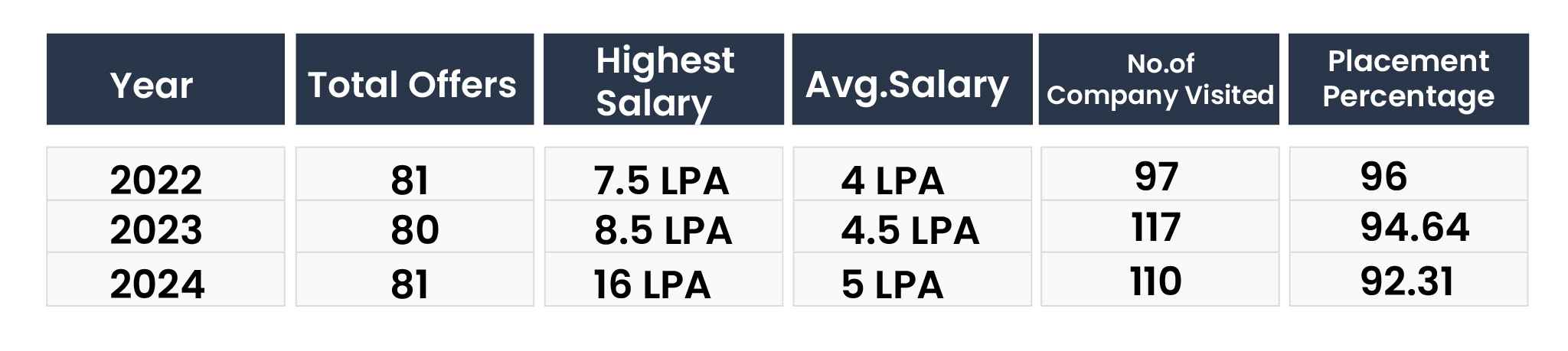
Since the Department of Placement and Training was established in 2005, it has focused on creating strong career pathways for every student. These include campus placements, support for entrepreneurship and startups, and guidance for higher studies. Our students are recruited by leading organisations such as:
• Deloitte, Accenture, TCS, Tech Mahindra and LTIMindtree
• Thoughtworks, HSBC, Siemens, Flipkart, Jio Platforms and Kyndryl
• Zoho, DevRev, Johnson Controls, ADP, Hexaware and Mu Sigma
• Bajaj Finserv, ITC Infotech, L&T Technology Services, Atos and Renault Nissan
Key Features
Cutting-Edge Curriculum: Offers a future-focused curriculum emphasizing enterprise IT systems, scalable cloud solutions, and agile methodologies tailored for contemporary technological needs.
User-Centric Design Excellence: Equips students to design intuitive, efficient IT solutions that enhance user experience and satisfaction.
Data-Driven Decision-Making: Provides in-depth training in data analytics, visualization, and IT frameworks to derive actionable insights for business and technology.
Integration of Emerging Technologies: Combines IT expertise with advancements in IoT, Blockchain, and edge computing to solve complex, real-world challenges.
Real-World Project Exposure: Encourages hands-on experience through industry-aligned projects addressing emerging market demands.
Global Competency: Offers exposure to international IT standards and frameworks, ensuring students are equipped to succeed in a globalized tech industry.
IT Governance and Compliance: Focuses on risk management, regulatory compliance, and IT policy formulation to ensure secure and efficient IT operations.
Digital Transformation Expertise: Trains students in key areas such as cloud migration, IT automation, and enterprise resource planning for the digital era.
Alignment with Industry 4.0: Develops professionals skilled in smart technologies and automation, driving the growth of intelligent industries.
Comprehensive Full-Stack Development: Provides hands-on training in designing and implementing robust front-end and back-end IT systems.
Strategic Problem-Solving Abilities: Cultivates innovative thinking to design IT solutions that address critical enterprise challenges effectively.
Collaborative and Interdisciplinary Learning: Encourages teamwork and cross-disciplinary collaboration to tackle IT-focused projects innovatively.
Entrepreneurial Ecosystem: Offers mentorship and resources for students to launch IT startups and innovative ventures, fostering a spirit of entrepreneurship.
Industry and Community Engagement: Actively involves students in IT forums, technology conferences, and industry collaborations to enhance learning and networking.
Commitment to Lifelong Learning: Instills adaptive IT skills, preparing students to thrive in an ever-evolving technological landscape.
Placement Data
Centre of Excellence


Eminent Alumni
News and Events
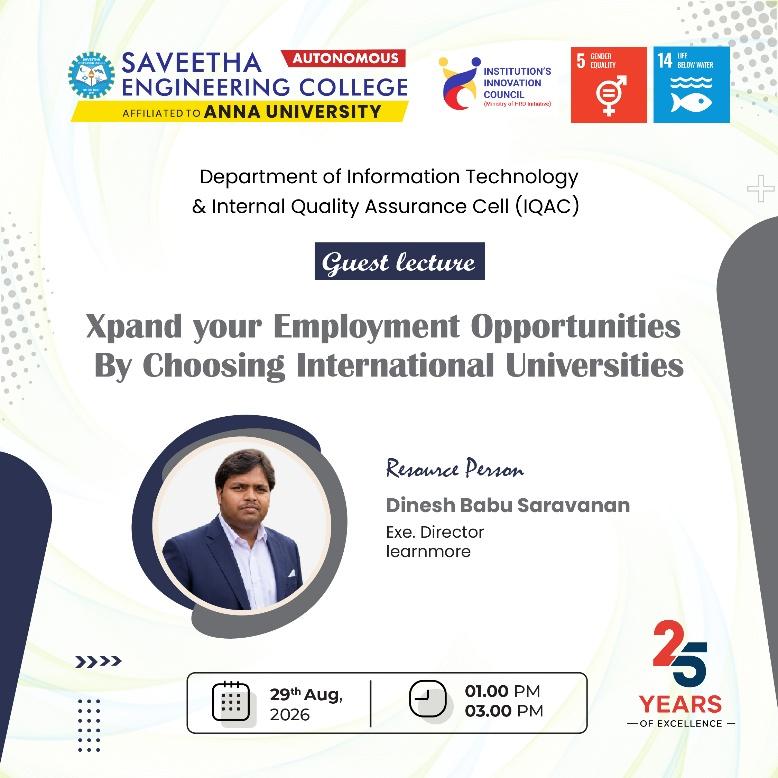
Xpand your Employment Opportunities By Choosing International Universities
The Department of Information Technology and the Internal Quality Assurance Cell (IQAC) organised a guest lecture on “Xpand Your Employment
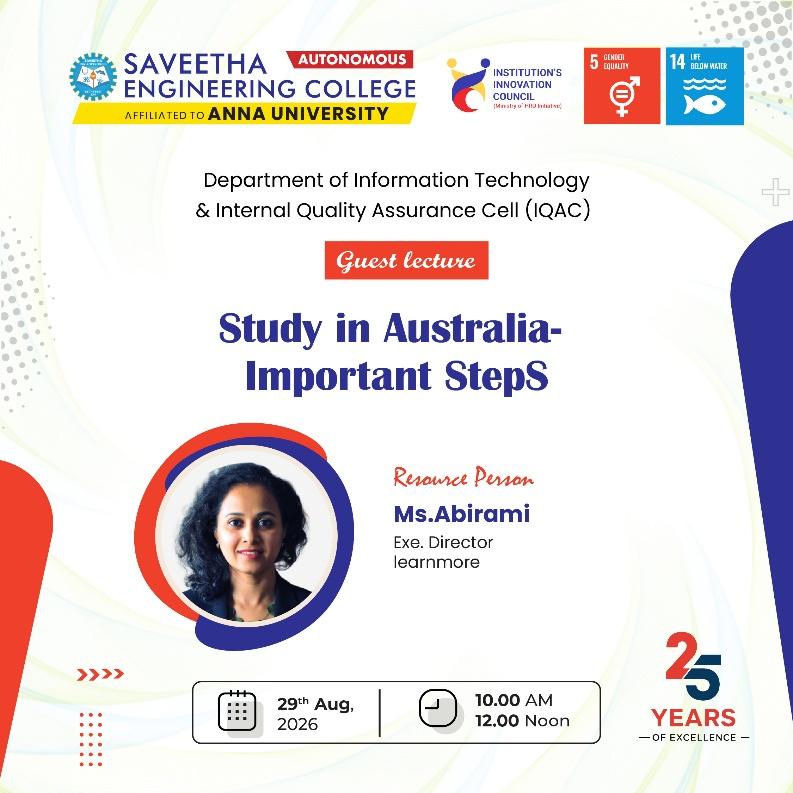
Study in Australia- Important Steps
The Department of Information Technology and the Internal Quality Assurance Cell (IQAC) organised a guest lecture on “Study in Australia
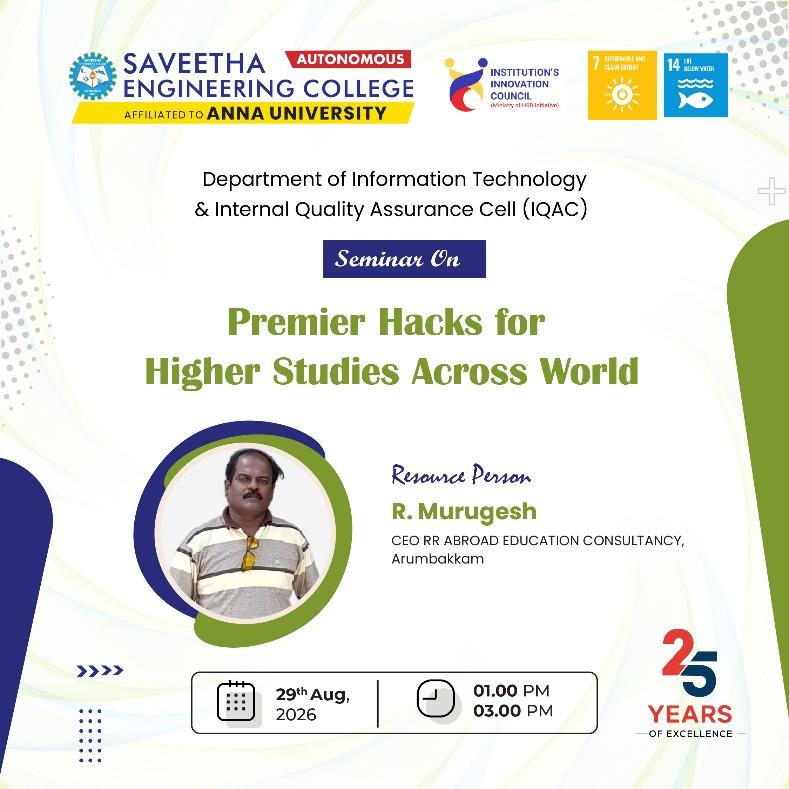
Premier Hacks for Higher Studies Across World
The Department of Information Technology and the Internal Quality Assurance Cell (IQAC) organised a seminar on “Premier Hacks for Higher
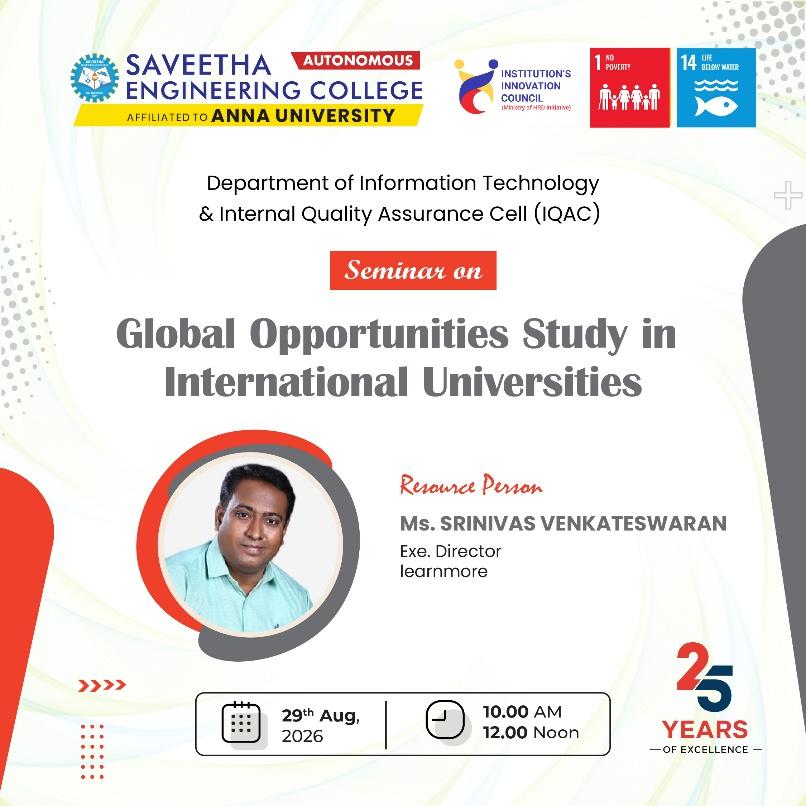
Global Opportunities Study in International Universities
The Department of Information Technology and the Internal Quality Assurance Cell (IQAC) organised a seminar on “Global Opportunities: Study in
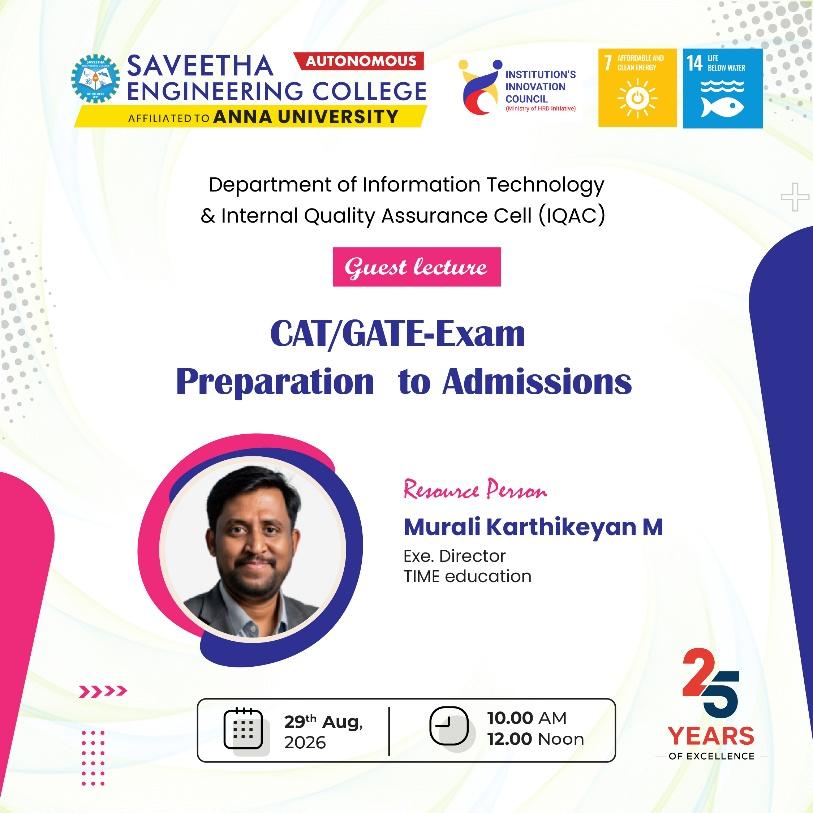
CAT/GATE-Exam Preparation to Admissions
The Department of Information Technology and the Internal Quality Assurance Cell (IQAC) organised a guest lecture on “CAT/GATE Exam Preparation
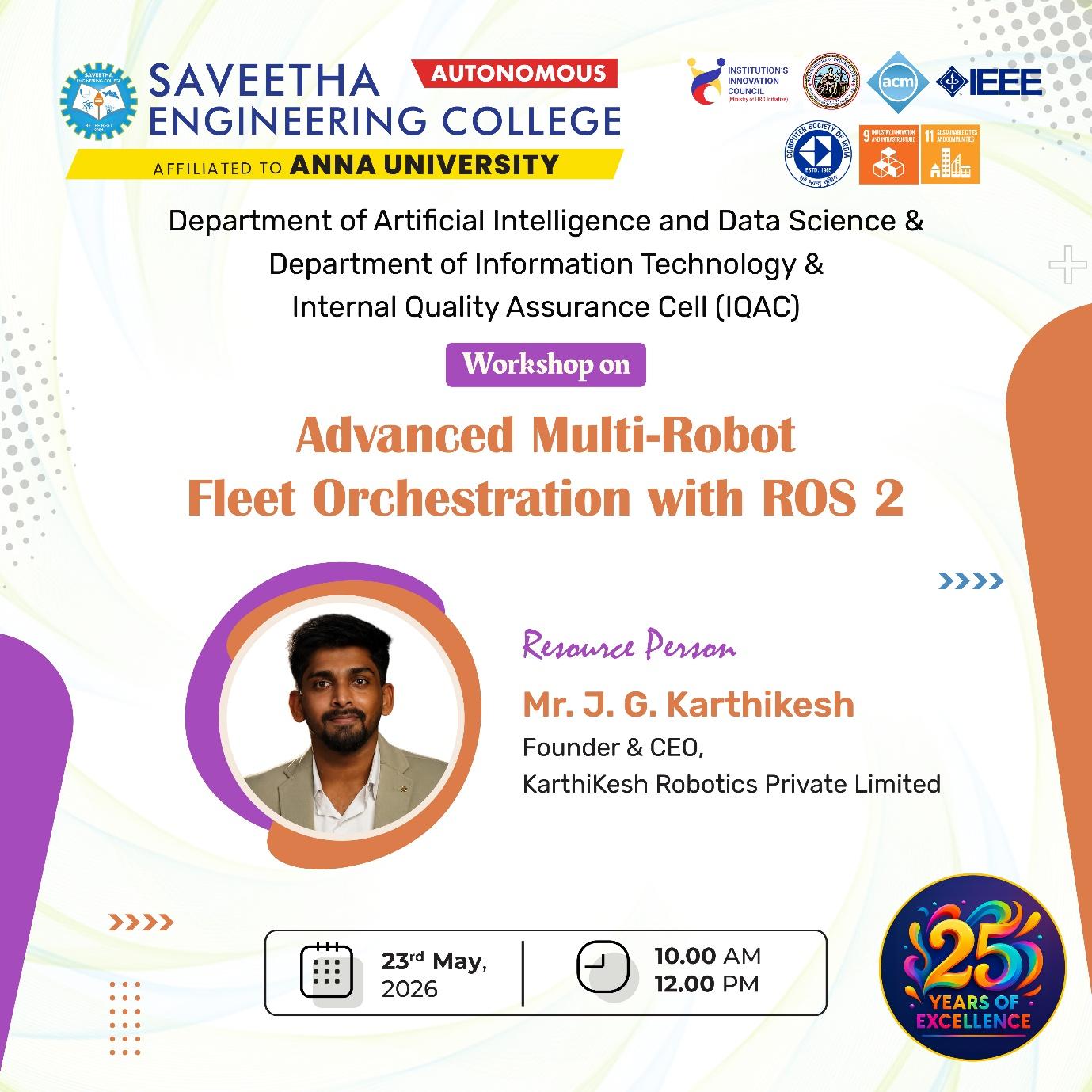
Advanced Multi-Robot Fleet Orchestration with ROS 2
The Department of Artificial Intelligence and Data Science and the Department of Information Technology, along with the IQAC, organised a
VISION
Department of Information Technology will impart futuristic technical education and instil high patterns of discipline through our dedicated staff, who shall set global standards, making our students technologically superior and ethically strong.
MISSION
Our mission is to educate students, so that they become enlightened individuals, improving the living standards of their families, industry and society through Information Technology. We will provide individual attention, world-class quality education and take care of character building.
PROGRAMME EDUCATIONAL OBJECTIVES (PEOs)
- To ensure graduates will be proficient in utilising the fundamental knowledge of basic sciences, mathematics and Information Technology for the applications relevant to various streams of Engineering and Technology.
- To enrich graduates with the core competencies necessary for applying knowledge of computers and telecommunications equipment to store, retrieve, transmit, manipulate and analyse data in the context of business enterprise.
- To enable graduates to think logically, pursue lifelong learning and will have the capacity to understand technical issues related to computing systems and to design optimal solutions.
- To enable graduates to develop hardware and software systems by understanding the importance of social, business and environmental needs in the human context.
- To enable graduates to gain employment in organisations and establish themselves as professionals by applying their technical skills to solve real-world problems and meet the diversified needs of industry, academia and research.
PROGRAMME OUTCOMES (POs)
- Engineering Knowledge: Apply fundamentals of math, science, and engineering to complex problems.
- Problem Analysis: Identify and analyze complex engineering problems to reach substantiated conclusions.
- Design/Development of Solutions: Design solutions for complex problems while considering public health, safety, and environmental factors.
- Conduct Investigations of Complex Problems: Use research-based methods, experiments, and data analysis to provide valid conclusions.
- Engineering Tool Usage: Apply modern engineering and IT tools with an understanding of their limitations.
- The Engineer and the World: Evaluate societal, health, safety, legal, and cultural responsibilities and sustainable development (merged from former PO6 and PO7).
- Ethics: Commit to professional ethics, human values, diversity, and inclusion.
- Individual and Collaborative Team Work: Function effectively as an individual and in multidisciplinary teams.
- Communication: Communicate effectively through reports, documentation, and presentations.
- Project Management and Finance: Apply engineering management and economic principles to manage projects.
- Life-Long Learning: Engage in independent and continuous learning amid technological changes.
PROGRAMME SPECIFIC OUTCOMES (PSOs)
Analyze, design, and implement IT solutions using modern tools and techniques to solve real-world enterprise and societal problems.
Leverage IT knowledge and computational skills to create entrepreneurial ventures, pursue higher education, or engage in innovation-driven careers.Â
Integrate technology with business processes to develop secure, sustainable, and ethical IT-enabled solutions.